How many kinds of hammers can you name? Most people picture a claw hammer. A few might add a rubber mallet, and gamers might imagine a medieval war hammer. Skilled trades and craft persons, however, recognize dozens of designs, each built for a distinct job. A dead-blow hammer absorbs rebound; a tack hammer secures delicate upholstery. In other words, they know their hammers.
U.S. labor lawyers, by contrast, tend to reason within a constrained, Wagner Model vocabulary. The familiar, almost provincial categories appear on cue: plant or craft units, exclusive representation or members-only models, and good-faith versus bad-faith bargaining. But recent scholarship has been broadening our imagination. Professor Kate Andrias’s influential work on “sectoral bargaining,” along with contributions from other legal academics, social scientists, one historian, think tanks (both progressive and conservative), and Harvard’s Clean Slate Program, are pushing bargaining beyond the NLRA’s tired categories. A diversity of public figures, from Senator Bernie Sanders, to Lyft President John Zimmer have also called for institutionalizing forms of sectoral bargaining. Yet critics, me included, have questioned whether many concrete examples, such as wage boards, actually involve bargaining at all. Professor Cynthia Estlund asserts they are systems of sectoral regulation, not bargaining.
Enter Professor Sara Slinn. In her upcoming chapter, Analytical Framework for Understanding Broader-Based and Sectoral Bargaining Models, Professor Slinn maps what counts as sectoral bargaining and what other tools exist. She argues that reform debates stall because scholars and policymakers use terms like “multi-employer,” “broader-based,” and “sectoral” interchangeably even though they describe different arrangements. Without a shared vocabulary, reform fragments. In other words, reformers need a clear analytical framework.
Slinn’s Conceptual Framework
Slinn turns to the International Labor Organization’s concept of “social dialogue.” This globally recognized term captures a wide range of labor-management-state relations and provides terminology that travels across legal systems. , Slinn also offers scholars and policymakers a more precise menu of options rather than a single vague solution, separating social dialogue into quadrants defined by type and level.
Slinn’s conceptual framework, reprinted with permission.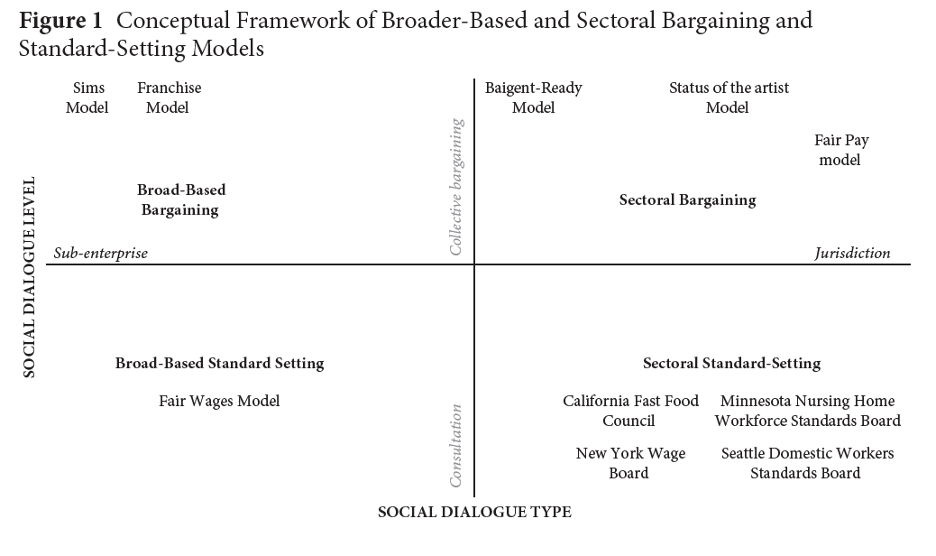
Her analysis operates along two dimensions. The first distinguishes types of social dialogue. At one end sits “consultation”: informal processes that help a decision-maker, often the state, develop standards or policies. At the other end sits “collective bargaining”: formal, party-driven processes that produce legally binding instruments. Between these poles lies a continuum that includes consultation and negotiation.
The second dimension distinguishes levels of centralization. At one end are sub-enterprise arrangements; at the other, jurisdiction-wide initiatives. Slinn places enterprise-level, sectoral, and multi-sectoral arrangements along this continuum.
Combining these dimensions produces four quadrants. The vertical axis runs from informal consultation to formal collective bargaining; the horizontal axis runs from decentralized models to centralized systems. Real-world arrangements can occupy any point in that conceptual space.
The Bipartite Domain: Collective Bargaining Beyond the Enterprise
The first two quadrants describe arrangements in which labor and management remain the primary actors. Government involvement recedes, allowing the parties’ agreements to dominate.
Quadrant I: Broader-Based Bargaining
These models expand bargaining beyond a single worksite without reaching full sectoral bargaining. Franchise bargaining, for example, would allow unions to negotiate with multiple franchisees tied to a common brand, addressing fragmentation that undermines traditional organizing. Similarly, the so-called “Sims” model once proposed in Canada would have allowed labor boards to consolidate bargaining units of a single employer across locations. Broader-based bargaining adapts the institution to fissured workplaces.
Quadrant II: Sectoral Bargaining
Here, negotiations extend across an entire industry or occupation. The Baigent-Ready model, proposed in 1990s British Columbia, would have altered certification rules to include small or historically excluded workplaces within a sector. Canada’s Status of the Artist regime also fits here. It certifies the most representative association of artists classified as independent contractors to bargain sector-wide and establish “scale agreements” that set minimum standards while allowing bargaining above them. New Zealand’s Fair Pay models operated similarly, establishing industry-wide floors that complemented enterprise-level agreements.
The Tripartite Domain: Standard-Setting as Social Dialogue
Where bargaining density is low or worker heterogeneity high, reform often shifts toward state-facilitated standard-setting. The final two quadrants capture these arrangements.
Quadrant III: Broader-Based Standard-Setting
Governments may impose wage standards or labor conditions at a sub-sectoral level. Ontario’s Government Contract Wages Act, for example, requires certain contractors to pay minimum wages in construction, building services, and security services when hired by the government or operating in government-controlled buildings. Although the state may consider collective bargaining agreements and Statistics Canada data, it need not consult social partners. The state can set standards unilaterally.
Quadrant IV: Sectoral Standard-Setting
Most U.S. wage boards—including fast-food and domestic worker boards—fit here. They exemplify centralized tripartite dialogue. These bodies bring labor, employers, and government together, but they issue recommendations rather than binding agreements. Applying ILO guidelines, Slinn distinguishes among “true tripartism,” “tripartism-plus” models that incorporate public members, and “civil-dialogue” arrangements that include advocacy organizations. The analytic boundary remains clear: standard-setting is state-led; collective bargaining is partner-led.
Clear-Eyed Reform Beyond the Hammer of “Sectoral Bargaining”
Scholars and policymakers should test this framework across cases of bargaining beyond the firm. Independent contractors may benefit from scale-agreement models that combine sectoral coordination with individual autonomy (if antitrust barriers can be overcome). Fragmented low-wage industries may require tripartite wage boards to establish baseline standards. Large employers operating across multiple sites may support broader-based bargaining that consolidates units without adopting full sectoral regimes. Institutional design should follow careful diagnosis of the work regime at issue.
In sum, labor law scholars, like skilled tradespeople, need more than a standard hammer. Slinn’s four-quadrant framework helps us identify, understand, and use the diverse tools available to rebuild institutions of collective bargaining.