Aug 11, 2026 Joseph Seiner
In Work Law’s Domain, Professor Ryan Nelson reveals our general “blindness” about who and how many people are really covered by work law generally and employment discrimination law in particular. (P. 60.) As Professor Nelson notes early in the piece, “this Article begins with a frightening claim: no one actually knows how illegal employment discrimination is in the United States.” (P. 59.) This is a startling claim and one that is fully developed over the course of the piece.
This article is superb because it is one of the few recent pieces of worklaw scholarship which provides a broader review of one of the pressing problems in this area – society and academia’s lack of a complete understanding of how to define the field. Rather than parsing particular parts of statutes or legislation, this Article performs the wonderful job of exploring how all the pieces (sometime fail) to fit together. This matters, Professor Nelson argues, because the “opacity of work law’s domain” makes it more difficult to understand, regulate, legislate, and improve that law. (P. 62.) This inability to fully regulate, legislate, and improve the area of labor and employment law has led to (arguably many artificial) constraints in this field.
Professor Nelson focuses on Title VII of the Civil Rights Act of 1964 – more specifically that it defines “employer” to mean only a person “who has fifteen or more employees for each working day” in at least twenty “calendar weeks” in “the current or preceding calendar year,” 42 U.S.C 2000e(b), and who is not otherwise exempted. He notes the estimates of employment discrimination which rely on this statute as well as “the sub-federal laws that fill Title VII’s gaps or Title VII’s myriad other exemptions.” (Pp. 62, 74.) Professor Nelson synthesizes this data and extrapolates from it to other areas of workplace law. In this way, he reveals how much we do not know the answers to basic questions, such as “’How many workers are protected against employment discrimination?’ ‘How many workers enjoy a right to earn a living wage?’, and ‘How many workers are guaranteed a safe workplace?’” (P. 62.)
Professor Nelson then explains how this lack of understanding causes tremendous problems, more specifically: an inability to effectively legislate or regulate; a difficulty of reporting in this field which can result in misinformation; a question over how to interpret religious objections; and how judges apply “major questions” doctrine to employment regulations. The paper provides a detailed analysis of each area, convincingly demonstrating the nature of the problem that has been created by our simple lack of understanding of the law.
After explaining the nature of the issue, and fully demonstrating how the confusion in this area has resulted in numerous ongoing problems, Professor Nelson goes a step further in discussing the best way to address the issue. He suggests that we reconsider how work law is measured, and explores what units of measurement might be used, discussing possible drawbacks of any particular measure. Professor Nelson carefully explores how – given this new understanding of the problem – the scholarship can more fully fix the problem. He notes the “heavy lift of mitigating these substantial problems via quantification of work law’s domain” that needs to be fully carried out for subsequent scholarship and analysis. (P. 62.) He therefore performs a superb job of setting the stage for future scholarship to address the problem. And hopefully, much of that future scholarship will come from Professor Nelson himself as he continues his research in this area.
While in some ways exploring this topic might seem academic in nature, the impact is far broader and can help guide claimants and practitioners in this area as we all grapple with how to more neatly define the scope of labor and employment law. For example, much of the litigation that the judiciary currently examines in the courts with respect to worklaw often explores basic questions of scope and coverage. Additionally, Professor Nelson’s work will certainly influence my own research on society’s struggles and current challenges surrounding dignity and work, because a basic question underlying those struggles is the scope of worklaw itself. Professor Nelson’s piece serves as an important reminder that there are many areas that worklaw may not currently touch – this does not make the importance of the proper treatment of workers or the obligation to provide dignity in employment any less important for individuals that may not fall outside of worklaw’s coverage. The more clearly we can define this area of the law, the better chance we have of providing protections and dignity to these workers across the country.
In short, Work Law’s Domain is extraordinarily well researched and exceptionally well written. It will serve to establish the new standard for society and the academy’s struggles in defining workplace law. As he appropriately concludes his piece, “[o]vercoming the many and substantial problems inherent in quantifying the breadth of work law would be a Herculean – possibly Sisyphean – task, but it would [be a] worthwhile one. Hopefully, this Article clears the path forward towards the ultimate goal of mapping the reaches of work law’s domain.” (P. 117.)
Jul 10, 2026 Michael C. Duff
Elizabeth Ford,
Thin Blue Advantage: Police Exceptionalism and the Two-Tier System of Public Sector Collective Bargaining, available at
SSRN (Feb. 11, 2026).
I really “like lots” Elizabeth Ford’s recently posted work-in-progress, Thin Blue Advantage: Police Exceptionalism and the Two-Tier System of Public Sector Collective Bargaining. The article is engaging as a careful empirical explanation of the great variety of collective bargaining agreements in use in the United States. But that is only the beginning of its accomplishments. At a deeper level, the article bravely takes on and reckons with the question that every union organizer in communities of color has faced: “why do police unions get away with so much?” (P. 45.)
Imagine you are a young worker of color who believes that white cops routinely get off the hook for brutalizing communities of color based on “technicalities” contained in “union contracts” about which you otherwise know little. Your initial exposure to the entire idea of collective bargaining is as a shelter for the exercise of illegitimate power. It is one thing for proponents of unions to argue, factually and correctly, that cops are workers, too. And people of good faith realize that the job of a police officer is horrendously dangerous. But many workers of color may still believe at the most basic level that union contracts protect racist cops. Telling them that they are simply wrong can make a bad situation worse.
Is the worker mistaken? Illegitimate “police power” arguments are hardly new. Police protect “capital.” Of course, police also protect people. Deep skeptics may wonder whether the police would be funded were it not for their capital-protective function. But it is not surprising that “abolish the police” movements sometimes run into headwinds blowing in from very mean streets.
A structure defending naked examples of the abuse of illegitimate power is hard to defend. Communities of color may be especially skeptical of police unionism. Professor Ford’s article deftly probes the back and forth of arguments between those adamantly promoting collective bargaining, as a general social good, and those insisting that labor rights must yield to elimination of racial discrimination and murderous bellicosity. (Pp. 6-9.) As a labor law scholar of color, I recall cases like Emporium Capwell Co. v. Western Addition, 420 U.S. 50 (1975), that have plumbed the racial tensions embedded in labor law.
Professor Ford lays out with care the factual basis of the claim that cops get away with racist policing. Police collective bargaining agreements – “union contracts” and the procedural job protections they confer – insulate unionized police officers from discipline better than any other collective bargaining agreement insulates any other worker against employer adverse actions. (Pp. 20-25.) Only slivers in the private sector are represented by unions (about 6%); or are protected in any sense by a union contract. Most workers are, as a result, “at will” employees. In the more densely unionized public sector workers are more frequently covered by union contracts. Police officers are more frequently covered than most other public sector workers.
Professor Ford provides a very good summation of exactly how police unions contracts are better. (Pp. 27-37.) Yet the article does not contend that these contracts should be “stripped down” to the level of a “typical” union contract. Rather, Professor Ford argues that union contracts of other public sector workers should be brought up to the standards of police union contracts. “[T]he article does not propose to constrain police bargaining to match everyone else. Instead, it suggests enhancements to level the playing field for all public workers.” (P. 5.) Thus, the overarching theme of the article is not an exercise of “race to the bottom,” lending comfort to those who oppose public sector unions, let alone unionized police. Professor Ford’s dilemma reminds me of debates surrounding first responders’ nearly exclusive entitlement to specialized workers’ compensation-related cancer protections; or its expanded access to workers’ compensation benefits during the pandemic as “essential workers.” The spirit of the article is one of rights expansion rather than taking rights away. Why shouldn’t more employees be considered essential?
The rights ultimately under discussion in the article are “bargaining rights.” (Pp. 20-21.) Essentially, police unions bargain on behalf of police officers for enhanced due process protections in their union contracts with municipal employers – relevant to this discussion in connection with violent encounters with citizens. Investigations surrounding such allegations implicate “working conditions.” In private sector, unionized workplaces (governed by federal law), such conditions must be collectively bargained with the union – they are “mandatory subjects of bargaining.”
If “good faith impasse” is reached over a mandatory subject of bargaining (that is, the parties are in honest deadlock), the employer may lawfully, unilaterally “implement on impasse” the “subject” for which it advocates. If the union does not like this development, the union may lawfully strike. If the union strikes, the employer may lawfully permanently replace strikers. This process usually places unions in a very weak position. The cycle described is textbook labor law. But state-law, public sector unionized employees (like the police) usually cannot strike under state law (Professor Ford’s chronicling of state collective bargaining law history is clear and accessible throughout the article. See Pp. 9-20.)
Although the legal system is (in most states) satisfied with the inability of public sector workers to strike, the situation is different with respect to the police. Because the police might strike, and because the police work in dangerous, essential jobs, everything possible must be done to discourage them from striking. (P. 14.) So, the story goes, public employers are not permitted to implement on impasse, a process that might generate a strike. (Pp. 13-14.) Instead, they must submit disputes to state-specific “impasse panels’ or “arbitrators” or “commissions” of various sorts. These neutral figures possess the authority to implement their own “fair” (often highly protective) versions of disputed bargaining procedures. Such a union-friendly procedure would be unthinkable both under federal labor law and under the labor law of most states. (P. 14.) Thus, police officers are investigated under procedures amenable to due process and generally unavailable to other unionized workers. Professor Ford admirably documents labor law differences between states.
This is a good read for labor lawyers, and will also be of broad general interest. I’m not sure if it will satisfy communities of color, or my hypothetical young worker, but it is a good attempt at trying to fix problems without hurting workers. A final virtue of the article is that it reveals the wide array of union bargaining models used across the country. For those advocating substitution of state labor law for federal labor law in the U.S., the article shows that in that case some workers would be much better off than others.
Jun 11, 2026 Cesar Rosado Marzán
How many kinds of hammers can you name? Most people picture a claw hammer. A few might add a rubber mallet, and gamers might imagine a medieval war hammer. Skilled trades and craft persons, however, recognize dozens of designs, each built for a distinct job. A dead-blow hammer absorbs rebound; a tack hammer secures delicate upholstery. In other words, they know their hammers.
U.S. labor lawyers, by contrast, tend to reason within a constrained, Wagner Model vocabulary. The familiar, almost provincial categories appear on cue: plant or craft units, exclusive representation or members-only models, and good-faith versus bad-faith bargaining. But recent scholarship has been broadening our imagination. Professor Kate Andrias’s influential work on “sectoral bargaining,” along with contributions from other legal academics, social scientists, one historian, think tanks (both progressive and conservative), and Harvard’s Clean Slate Program, are pushing bargaining beyond the NLRA’s tired categories. A diversity of public figures, from Senator Bernie Sanders, to Lyft President John Zimmer have also called for institutionalizing forms of sectoral bargaining. Yet critics, me included, have questioned whether many concrete examples, such as wage boards, actually involve bargaining at all. Professor Cynthia Estlund asserts they are systems of sectoral regulation, not bargaining.
Enter Professor Sara Slinn. In her upcoming chapter, Analytical Framework for Understanding Broader-Based and Sectoral Bargaining Models, Professor Slinn maps what counts as sectoral bargaining and what other tools exist. She argues that reform debates stall because scholars and policymakers use terms like “multi-employer,” “broader-based,” and “sectoral” interchangeably even though they describe different arrangements. Without a shared vocabulary, reform fragments. In other words, reformers need a clear analytical framework.
Slinn’s Conceptual Framework
Slinn turns to the International Labor Organization’s concept of “social dialogue.” This globally recognized term captures a wide range of labor-management-state relations and provides terminology that travels across legal systems. , Slinn also offers scholars and policymakers a more precise menu of options rather than a single vague solution, separating social dialogue into quadrants defined by type and level.
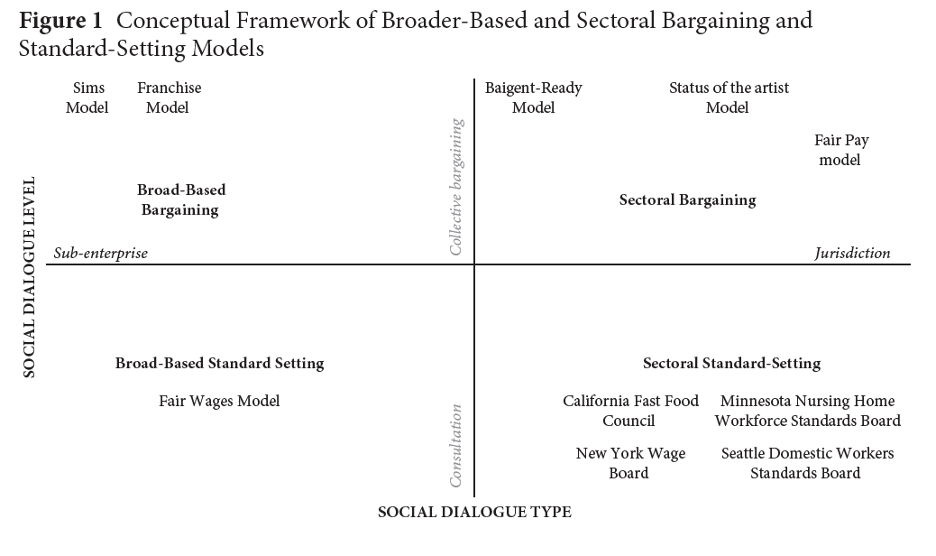
Slinn’s conceptual framework, reprinted with permission.
Her analysis operates along two dimensions. The first distinguishes types of social dialogue. At one end sits “consultation”: informal processes that help a decision-maker, often the state, develop standards or policies. At the other end sits “collective bargaining”: formal, party-driven processes that produce legally binding instruments. Between these poles lies a continuum that includes consultation and negotiation.
The second dimension distinguishes levels of centralization. At one end are sub-enterprise arrangements; at the other, jurisdiction-wide initiatives. Slinn places enterprise-level, sectoral, and multi-sectoral arrangements along this continuum.
Combining these dimensions produces four quadrants. The vertical axis runs from informal consultation to formal collective bargaining; the horizontal axis runs from decentralized models to centralized systems. Real-world arrangements can occupy any point in that conceptual space.
The Bipartite Domain: Collective Bargaining Beyond the Enterprise
The first two quadrants describe arrangements in which labor and management remain the primary actors. Government involvement recedes, allowing the parties’ agreements to dominate.
Quadrant I: Broader-Based Bargaining
These models expand bargaining beyond a single worksite without reaching full sectoral bargaining. Franchise bargaining, for example, would allow unions to negotiate with multiple franchisees tied to a common brand, addressing fragmentation that undermines traditional organizing. Similarly, the so-called “Sims” model once proposed in Canada would have allowed labor boards to consolidate bargaining units of a single employer across locations. Broader-based bargaining adapts the institution to fissured workplaces.
Quadrant II: Sectoral Bargaining
Here, negotiations extend across an entire industry or occupation. The Baigent-Ready model, proposed in 1990s British Columbia, would have altered certification rules to include small or historically excluded workplaces within a sector. Canada’s Status of the Artist regime also fits here. It certifies the most representative association of artists classified as independent contractors to bargain sector-wide and establish “scale agreements” that set minimum standards while allowing bargaining above them. New Zealand’s Fair Pay models operated similarly, establishing industry-wide floors that complemented enterprise-level agreements.
The Tripartite Domain: Standard-Setting as Social Dialogue
Where bargaining density is low or worker heterogeneity high, reform often shifts toward state-facilitated standard-setting. The final two quadrants capture these arrangements.
Quadrant III: Broader-Based Standard-Setting
Governments may impose wage standards or labor conditions at a sub-sectoral level. Ontario’s Government Contract Wages Act, for example, requires certain contractors to pay minimum wages in construction, building services, and security services when hired by the government or operating in government-controlled buildings. Although the state may consider collective bargaining agreements and Statistics Canada data, it need not consult social partners. The state can set standards unilaterally.
Quadrant IV: Sectoral Standard-Setting
Most U.S. wage boards—including fast-food and domestic worker boards—fit here. They exemplify centralized tripartite dialogue. These bodies bring labor, employers, and government together, but they issue recommendations rather than binding agreements. Applying ILO guidelines, Slinn distinguishes among “true tripartism,” “tripartism-plus” models that incorporate public members, and “civil-dialogue” arrangements that include advocacy organizations. The analytic boundary remains clear: standard-setting is state-led; collective bargaining is partner-led.
Clear-Eyed Reform Beyond the Hammer of “Sectoral Bargaining”
Scholars and policymakers should test this framework across cases of bargaining beyond the firm. Independent contractors may benefit from scale-agreement models that combine sectoral coordination with individual autonomy (if antitrust barriers can be overcome). Fragmented low-wage industries may require tripartite wage boards to establish baseline standards. Large employers operating across multiple sites may support broader-based bargaining that consolidates units without adopting full sectoral regimes. Institutional design should follow careful diagnosis of the work regime at issue.
In sum, labor law scholars, like skilled tradespeople, need more than a standard hammer. Slinn’s four-quadrant framework helps us identify, understand, and use the diverse tools available to rebuild institutions of collective bargaining.
Cite as: Cesar Rosado Marzán,
Tools to Clear the “Sectoral Bargaining” Fog, JOTWELL
(June 11, 2026) (reviewing Sara Slinn,
Analytical Framework for Exploring Broader-based and Sectoral Bargaining in the North American Wagner Model Context, in
The Law and Collective Bargaining: Sources and Patterns of Regulation in the Modern World of Work (Alexis Bugada, Anthony Forsyth & Paolo Tomassetti, eds. 2026)),
https://worklaw.jotwell.com/tools-to-clear-the-sectoral-bargaining-fog/.
May 13, 2026 Kerri Lynn Stone
In this provocative article, Bill Corbett traces recent developments in Title VII employment discrimination law by analyzing two Supreme Court decisions, Ames v. Ohio Department of Youth Services, 605 U.S. 303 (2025), and Muldrow v. City of St. Louis, 601 U.S. 346 (2024), as well as how textualism has imperiled the McDonnell Douglas doctrine. (Courts have used this three-part burden-shifting framework to decide the issue of discrimination under various statutes since the early 1970’s. The McDonnell Douglas doctrine puts the burden on the plaintiff to create an inference of discrimination, then permits the defendant to offer a legitimate, nondiscriminatory reason for its action. The plaintiff shoulders the ultimate burden of persuasion by proving pretext, and thus, the ultimate fact of the discrimination.) Corbett concludes that an “escalating textualist purge of employment discrimination law is fashioning a body of law that differs significantly from the one that has developed over six decades.” (P. 37.) He predicts that, as a result, courts will be less likely to grant employer-defendants’ motions for summary judgment on plaintiffs’ Title VII claims.
In his analysis, Corbett reads Muldrow as a case in which the Court deploys textualism to eschew “heightened standards for actionable adverse employment actions,” and Ames as further confirming that Title VII exists to protect individuals and not groups. (P. 36.) From this, he infers Muldrow and Ames will cause more Title VII cases to make it to trial, and more filing of discrimination claims, especially so-called “reverse discrimination” claims.
Corbett then points to Justice Thomas’s concurrence in Ames as a specific sign of “the most dramatic pro-employee plaintiff shift yet, with roots in a textualist approach.” In a section of the article entitled “Is McDonnell Douglas next,” Corbett questions whether this concurrence, as well as Justice Thomas’s dissent from the cert. denial in Hittle v. City of Stockton, 145 S. Ct. 759 (2025), foretell that doctrine’s demise. These opinions highlight the framework’s lack of a basis in Title VII’s statutory text, how cumbersome it has been for courts to apply, and Justice Thomas’s and possibly others’ appetite for revisiting it.
Corbett reads Justice Thomas as criticizing the McDonnell Douglas framework as ill-suited for deciding summary judgment claims and not capturing the multitude of ways that a Title VII plaintiff can show discrimination against an individual “because of such individual’s” protected class status. In so doing, Corbett explains how he agrees and disagrees with Justice Thomas. Although the Supreme Court never has, lower courts often apply the McDonnell Douglas framework “to the sufficiency standard for summary judgment.” (P. 49.) Corbett sees no “fatal flaw of inconsistency with the summary judgment standard,” as Thomas does, yet he agrees with Thomas that courts apply McDonnell Douglas in a heavy-handed manner that asks too much of plaintiffs. (Pp. 50-51.) But Corbett, unlike Justice Thomas and others, does not appear to see the potential rollback of the framework as an issue couched so much in textualism as in its failure to comport with the correct analysis of the ultimate question in Title VII cases: Did discrimination occur “because of” a plaintiff’s race, sex, or another protected category? For similar discussion, see Tynes v. Florida Dep’t of Juvenile Justice, 88 F.4th 939, 949-958 (11th Cir. 2023) (Newsom, J., concurring).
What happens if McDonnell Douglas is overruled? Corbett predicts that courts would return to applying the actual summary judgment standard — whether there is no genuine dispute of material fact on whether the defendant likely acted “because of” an individual’s protected category in violation of Title VII, section 703(a), or on whether it was at least a “motivating factor”. As a result, more Title VII claims would survive past summary judgment. Interestingly, though, Corbett notes that even if the Court were to liberate the summary judgment analysis from McDonnell Douglas, it would not help plaintiffs’ claims under employment discrimination law outside of Title VII, because those plaintiffs would still need to “satisfy the more demanding standard of but-for causation,” though those plaintiffs would nonetheless still “benefit from not being required to fit their evidence into the prima facie case and pretext stages of McDonnell Douglas.” (Pp. 53-54.)
Finally, Corbett asks “[W]hat else might a textualist Supreme Court strip away?” He points to other “atextual” readings of Title VII, including the doctrine for employer liability for supervisor workplace harassment, and well as, in the lower courts, the stray remarks doctrine, the same-actor inference, and the same-class inference. He makes excellent points about how these judge-made doctrines are inconsistent with Title VII’s text and purposes. All in all, this is a provocative read about the result of textualists’ approach to ridding the law of unhelpful doctrines.
Cite as: Kerri Lynn Stone,
Textualism’s Trajectory, JOTWELL
(May 13, 2026) (reviewing William R. Corbett,
Stripping Title VII Down to Its Bare Essentials: Uncovering an Employee-Friendly Employment Discrimination Law, 94
Geo. Wash. L. Rev. 35 (2025)),
https://worklaw.jotwell.com/textualisms-trajectory/.
Apr 17, 2026 Michael Z. Green
Michael Selmi,
DEI and the Private Workplace, available at
SSRN (September 11, 2025).
Professor Michael Selmi’s 2025 essay, DEI and the Private Workplace, examines some of the court rulings in the “upwards of one hundred cases filed” challenging the legality of workplace diversity, equity, and inclusion (DEI) practices after the Supreme Court’s 2023 decision in Students for Fair Admissions, Inc. v. President and Fellows of Harvard College, (“SFFA”). (Pp. 3-4 n.7.) SFFA concerned challenges to affirmative action practices in the college admissions setting as violating the U.S. Constitution’s Equal Protection Clause and Title VI of the Civil Rights Act. In analyzing DEI cases, Selmi notes “the long history of workplace affirmative action which differs significantly from the educational setting.” (P. 1.) Nonetheless, advocates have relied on SFFA in suing private sector employers and arguing their DEI practices violate federal discrimination statutes. (Pp. 3-4 n.7.) In his essay, Selmi examines how much SFFA “affects private efforts to diversify a workforce and what legal guidance there is on those efforts.” (P. 5.) Selmi also explains how the anti-DEI workplace cases are mostly like so-called reverse discrimination cases, that most of those anti-DEI lawsuits have failed, and that federal law still permits private-sector employers to pursue some forms of DEI.
Selmi starts with “debates” that arose during “the passage of the Civil Rights Act of 1964″ regarding how “affirmative action” would affect the development of employment discrimination law. (P. 1.) Even back then, there were “concerns that white men would be passed over by unqualified Blacks or other minorities, a view that was reflected in some of the early cases” after Title VII’s passage. (Pp. 1-2.) According to Selmi, in cases from “1979 to the late 1980s, the Supreme Court” read Title VII of the Civil Rights Act of 1964, which prohibits some kinds of employment discrimination, to allow employers, under certain circumstances, to adopt affirmative action plans based on race or sex. United Steelworkers v. Weber, Johnson v. Transportation Agency. (Thereafter, some lower courts extended those cases to cover race discrimination challenges to affirmative action plans under 42 U.S.C. 1981 (e.g. Setser v. Novack Inv. Co., 657 F.2d 962, 966-67 (8th Cir. 1981); Schurr v. Resorts Int’l Hotel, Inc., 196 F.3d 486, 499 (3d Cir. 1999) (P. 25 nn. 98-99.)) As a result, there have been “very few challenges, particularly in the lower courts,” to private-sector employer affirmative action plans. (P. 2.) Instead, most of the successful workplace affirmative action challenges argued that public sector employers, by adopting such plans, violated the Equal Protection Clause of the U.S. Constitution, which does not apply to private sector employers. Id.
Selmi finds that “many of the current challenges to DEI programs closely resemble” cases from those “early years of Title VII.” (Pp. 27-28.) Those were “reverse discrimination cases in which most commonly white individuals allege that they were the victims of discrimination.” Id. Those cases “have traditionally been difficult to win” which is not surprising as “discrimination claims of any type are notoriously difficult to win.” (P. 27.)
But after SFFA, the challenges have moved away from affirmative action complaints to reverse discrimination claims based upon DEI practices. Selmi asserts that these actions do not clarify what DEI practices are, other than asserting broadly any workplace actions that are “invariably race conscious.” As Selmi clarifies, DEI is not just a weak form of affirmative action. Rather, if Title VII permits a voluntary affirmative action plan, it must at least aim to correct a manifest racial or gender imbalance in traditionally segregated job categories. In contrast, DEI practices aim more broadly to create an inclusive workplace where employees want to continue working.
In reviewing “litigated cases to date [at least through early 2025, P.3 n.7],” Selmi concludes that “significantly more of the cases have been unsuccessful as opposed to successful.” (P. 31.) He acknowledges some risk-averse employers have responded by changing or abandoning DEI practices just to avoid litigation. Near the end of the essay, Selmi reviews two cases, decided after SFFA, where anti-DEI challenges arguably succeeded: Am. All. for Equal Rts. v. Fearless Fund Mgmt., LLC, 103 F.4th 765 (11th Cir. 2024) (preliminary injunction of venture capital fund’s $20,000 grant contest for Black women businesses for likely violating 42 U.S.C. § 1981) and Duvall v. Novant Health, Inc., 95 F.4th 778 (4th Cir. 2024) (approving Title VII jury verdict for white male replaced by non-white employee during employer efforts to meet “three-to-five year goals to diversify … executive and senior level teams”) (P. 43.)
For Selmi, SFFA likely did not affect the Fearless Fund and Novant Health outcomes. Instead, the Fearless Fund case coincided with a series of challenges to diversity fellowships, scholarships, internships, and financial programs. Many organizations, including Fearless Fund, can avoid liability under anti-discrimination laws by focusing on awarding their grants, scholarships, or other benefits to individuals based on other grounds, such as socio-economic status, instead of race or sex. Likewise, the result in Novant Health followed those small percentage of employment discrimination cases with enough evidence to get to a jury trial, similar to how most discrimination lawsuits worked before SFFA.
Finally, Selmi describes several cases that have challenged employer-mandated DEI training. Selmi finds most of these cases “have failed and broad claims that DEI programs are inherently discriminatory are likely to fail regardless of the underlying claim.” (P. 47.) He also concludes that “private employers that want to take steps to diversify their workplace and enhance that diversity continue to have the legal runway to do so, particularly if those efforts are … designed to enrich the workplace without relying on race or gender conscious preferences.” (P. 53.) Whether you agree or not about challenging the legality of DEI, you should read Selmi’s essay. If businesses continue to keep defeating anti-DEI advocates in these lawsuits throughout 2026, both sides, as well as workplace law scholars, invested in reviewing these issues, may find Selmi’s essay helpful, as I did, in analyzing any ongoing legal challenges.
Mar 16, 2026 Henry L. Chambers, Jr.
Dallan K. Flake,
Undue Hardship after Groff, available at
SSRN (Aug. 19, 2024).
In Undue Hardship after Groff, Professor Dallan K. Flake considers an issue raised in the Supreme Court’s recent revision of the meaning of undue hardship in Groff v. DeJoy, 600 U.S. 447 (2023). He proposes a corrective to the Court’s requirement that an employer who claims that an accommodation triggers an undue hardship on its business because of the accommodation’s negative effects on the non-accommodated employees must prove those effects have “a negative impact on their business.” (P 3.) Flake suggests courts take judicial notice that lowered employee morale stemming from workplace accommodations for religious practices negatively affects an employer’s business. He argues that social science studies are so clear that lower employee morale leads to negative effects on an employer’s business that the Court’s requirement should essentially be ignored.
Flake’s solution is simple and intriguing. Reading the article will encourage those who care about religious discrimination to wrestle with the changing landscape of workplace accommodation. Students learning the law, lawyers counseling clients, and courts interpreting the law must consider practical issues of proof that the Supreme Court may not have fully considered when reshaping the law. This article takes a big swing at one of the issues. Given the lack of clarity that remains around what constitutes undue hardship, many issues will need to be litigated to flesh out the contours of the new doctrine. If courts take Flake’s proposal seriously, the Supreme Court will need to revisit the relationship between employee morale and harm to an employer’s business.
The Court remade the law on reasonable accommodation in Groff by redefining the undue hardship test as interpreted in TWA v. Hardison, 432 U.S. 63 (1977). Under Title VII, employers must provide reasonable accommodation for an employee’s religion if such accommodation does not trigger undue hardship on the employer’s business. In Hardison, the Court considered whether TWA needed to accommodate an employee whose religious beliefs did not allow him to work on his Sabbath. The relevant workplace had to be staffed 24 hours a day. Accommodating the employee would have required limiting fellow coworkers’ use of their earned seniority rights or having TWA pay overtime wages or other additional costs.
The Hardison Court decided that rearranging seniority rights or requiring TWA to pay more than de minimis costs would be an undue hardship. However, in Groff, the Court explained that notwithstanding Hardison’s reference to de minimis costs, the burden necessary to trigger undue hardship must be “substantial in the overall context of an employer’s business.” (600 U.S. at 468). The Court then noted that a religious accommodation that negatively affects employee morale might trigger undue hardship but only if it would negatively affect the employer’s business.
Flake argues the link between lower employee morale and negative effects on business are so clear that proving the link is unnecessary. He considers different types of accommodations and how those accommodations can affect coworkers and their morale. Then, he considers social science research on worker morale and organizational outcomes, arguing that the research indicates worker morale affects absenteeism, burnout and turnover, organizational citizenship behavior, and task performance. All these factors drive performance and business results. Flake argues: “While the link between morale and organizational outcomes is complex and nuanced, the ultimate conclusion is straightforward and unequivocal: When worker morale decreases, employers pay a hefty price.” (P. 32.) Consequently, using judicial notice – which treats an issue that is readily apparent as if it has been proven without additional evidence – is a sensible response to the Court’s directive.
Even if courts adopt Flake’s approach, the inquiry’s focus merely shifts to why morale declined and how much it declined. The Groff Court noted that decreases in morale that are based on religious animus cannot trigger undue hardship. Rather, the decrease in morale must be linked directly to the effect the accommodation has on the coworker. This distinction can be difficult to make, especially if the decrease in morale is based on concerns about the sincerity of an employee’s religious belief. However, that is an issue that future litigation must resolve.
As important, an employer must prove that accommodating the employee would cause coworker morale to sink so low that the effect on the employer’s business would be substantial. Barring such an effect on the employer’s business, hardship may exist, but it would not be undue. Determining when and how the threshold for substantial harm is met will be difficult. However, Flake would almost certainly argue that issue is more important to the accommodation analysis than the Court’s requirement of proof that lowered morale triggers harm to the business.
The article trenches on a broader question: How burdensome must accommodating an employee’s religion be before doing so is deemed to cause undue hardship? The question matters because the Groff Court changed the answer. Flake’s article does not attempt to solve the whole issue but addresses a piece of it. He covers the piece at a nice pace and level that is accessible to those steeped in employment discrimination law and those who do not practice in the area. There is much more in the article for experts and novices alike to consider but, at forty pages, it is not exhaustively long. Given that, I recommend this article to all.
Feb 13, 2026 Joseph Slater
A key priority of the second Trump administration has been an unprecedented attack on federal employees’ workplace rights. This includes removing collective bargaining rights, dismantling federal agencies, and working to remove the civil service protections of many federal employees. Catherine Fisk’s Democracy and a Nonpartisan Civil Service focuses on the assault on civil service. The article gives a history of civil service laws and reviews the evidence on the benefits and costs of their protections. It details the assaults on these protections and provides a nuanced defense of them. Fisk convincingly addresses legal, practical, and policy concerns, describing current rules, proposed changes, , theoretical arguments, and relevant empirical data. Her article is a strong contribution to the literature.
Since the Pendleton Act of 1883, civil service rules have been a key component of employment law in federal, state, and local government. Such laws originally aimed to combat political patronage practices by providing “merit” rules for both hiring and firing. By the second half of the mid-20th century, these rules gave most lower- to mid-level public employees just cause discharge protection, at least after a probationary period. While most other industrialized democracies in that period adopted just cause rules as the default for most employees, the United States remained, except for civil service laws, committed to at-will employment.
In the early 21st Century, conservatives began attacking civil service rules. During the first G.W. Bush administration, the Heritage Foundation claimed that civil service rules protected federal employees who opposed conservative presidents’ policies – a precursor to the “deep state” language of the first Trump administration, embodied in “Schedule F,” which would have created a large new class of federal employees who were dischargeable at will. Meanwhile, several Republican-led states, e.g., Florida and Texas, amended their state civil service rules to remove or greatly weaken civil service protections
These attacks have affected, or soon will affect, basic employment rights of hundreds of thousands of workers and could significantly change how governments operate. Fisk does an admirable job of placing them in context.
She starts by noting that the justifications for Trump’s 2025 Executive Order on civil service include making federal employees “accountable to the President,” addressing the predominance of “liberals among the civil service,” and aiming to make all federal employees fireable at will. (Pp. 2-3.) Like the proposed “Schedule F,” it greatly expands the definition of “policy-making” employees exempt from just cause protections.
Fisk’s discussion of empirical evidence is interesting and balanced. For example, she cites a study finding that some job security “improves governance by recruiting and retaining motivated and skilled employees to government,” while too much of it discourages good work and makes it too hard to fire bad employees. (P. 19.) The “consensus of the literature” is that while “some reforms are desirable . . . completely abolishing legal rights to job tenure during good behavior is an extremely risky proposition. . . .” (P. 20.) Her discussions of competing theories of government are also valuable, including the “unitary executive” theory that cuts against the heretofore established premise that the U.S. Constitution authorizes Congress to grant just-cause and related civil service protections to federal employees.
Fisk puts theories in context. The justification for Trump’s E.O. is that federal employees are “disproportionately liberal.” (P. 23.) Also, it would remove protections from “anyone who even views or circulates proposed regulations or guidance.” (P. 24.) This, Fisk argues, is also part of the administration’s attack on whistleblowers and union protections. (Pp. 24-26.)
The most direct challenge to the E.O. is that it violates the Civil Service Reform Act of 1978 (CSRA), which currently sets out federal civil service rules. Here, Fisk carefully describes the CSRA’s broad statutory language and concludes (Pp. 31-32) that even if the President can reclassify these positions prospectively, civil service and constitutional due process protections should prevent current employees from being reclassified into at-will status.
Fisk also notes the established rule that, that for non-policymaking public-sector jobs, discrimination on the basis of political affiliation violates the First Amendment (Pp. 38-40, Branti v. Finkel, 445 U.S. 507 (1980)). Anticipating that challenge, the 2025 E.O. states that employees need not support the current President or administration polices but must “faithfully implement administration policies to the best of their ability.” However, reports indicate that last January, the National Security Council interrogated many civil servants and examined their social media, asking if they supported Trump. The NSC then fired a large number weeks later. (P. 26.)
Fisk reviews other legal objections to this E.O, respectfully attending to both sides of the arguments. Significantly, she notes that in 2024, the Biden administration issued a regulation concluding that Scheule F was not consistent with good administration or with the CSRA. That creates issues under the Administrative Procedure Act as to whether Trump can unilaterally change these rules via an E.O.
Speaking as one of the few academics who study federal sector employment, I doubt I will like what will happen in this area in the next few years. But I predict this article will be very valuable. It is timely (and the recent adoption of a revised Schedule F only makes it timelier), important, well-researched, balanced, and thorough. I liked it a lot.
Jan 15, 2026 Anne Marie Lofaso
As I often remind my students, labor law stands among the most demanding courses in law school—not just for its intellectual rigor, but for the layered complexity it presents. Labor law is rooted in a dense statutory framework. It requires mastery of intersecting doctrines from constitutional, administrative, and contract law, all of which are interpreted through a case-heavy lens.
At its core, labor law grapples with deeply human issues—power dynamics, structural inequities, and the lived realities of working people. Its scope is wide and constantly in flux, shaped by the shifting politics of Board leadership and the broader currents of social change. But what makes it so compelling—so urgent—is that it is never abstract. It is relentlessly real. It forces us to grapple with clashing perspectives from workers, employers, and unions, each bringing their own lived experience and competing visions of fairness, autonomy, and justice.
Stefan McDaniel understands this complexity and the problems it causes. In Rearticulating Labor Rights, Professor McDaniel offers a refreshingly strategic intervention. McDaniel begins with a striking observation: Section 7 of the National Labor Relations Act (NLRA)—the bedrock of collective workplace rights, safeguarding union and nonunion employees in their efforts to organize, bargain collectively, and engage in concerted activity for mutual aid or protection—does not fail for lack of breadth. It fails because its protections are not easily communicated, understood, or internalized by those it aims to empower. (Pp. 197–205.) McDaniel demonstrates how existing rights fail to register in workers’ minds. McDaniel thereby reframes the problem of nonunion worker disempowerment as a failure of message design, delivery, and reception. Drawing on communication theory, the article proposes a doctrinal overhaul that is both modest in scope and ambitious in effect.
One of Professor McDaniel’s most original applications of communication theory explains a problem that has perplexed labor advocates for 90 years—how Section 7 can be so broad as to encompass the concerted activity of all private-sector, common-law employees (whether union or nonunion), but is rarely used to protect the millions of private-sector employees who are nonunion yet covered by the NLRA.
McDaniel explains that both psychological and structural barriers to Section 7 awareness cause the communication breakdown. Transmission of Section 7’s complex, nuanced, and highly technical message about workers’ rights to those nonunion workers who would most benefit from Section 7 protection is deeply flawed. These nonunion workers have low legal literacy, low civic engagement, weak traditions of collective action, and exposure to strong norms of managerial control. These nonunion workers, who depend on their jobs for survival, experience high job insecurity. Without exposure to competent mediators such as unions or labor advocacy groups, these nonunion workers receive Section 7’s message through more indirect, low-conductivity channels such as social media or co-workers. Even the Board’s messaging is indirect—summary commentary on its website.
Drawing on these insights, Professor McDaniel identifies three core problems that prevent Section 7 rights from reaching and empowering nonunion workers: reception, appreciation, and action. First, under the reception problem, workers rarely encounter the Section 7 message—or fail to recognize it when they do. The message gets buried in legal jargon and fuzzy standards, making it hard for anyone—let alone a nonunion worker—to figure out what counts as protected.
Employers often function as “insulators,” whether intentionally or not, filtering or distorting the message through discipline, silence, or subtle signals that convey: “don’t push it.” Even when the Section 7 message is technically present, it competes with more vivid and immediate signs of employer control, such as retaliation, wage theft, or surveillance, which suggest to workers that protest may be risky or futile.
Second, under the appreciation problem, even when workers receive the Section 7 message, they may not grasp its relevance or believe it applies to them. For many workers, especially in low-wage or unstable jobs, labor rights do not feel like something they can reach for—labor rights feel distant, abstract, maybe even dangerous. When legal language is dense and job security is fragile, it is no wonder workers default to playing it safe. They try to be decent, cooperative, conflict-averse—doing what they think will keep them employed. And in that environment, the idea of protected protest does not just seem risky—it barely registers.
Third, under the action problem, McDaniel argues that knowing the law is not enough. Workers must feel empowered to act. The complexity and ambiguity of current doctrine discourage boldness, leaving workers unsure whether their actions will be protected or punished. Without explicit, communicable protection, they hesitate to engage in concerted activity, even when their grievances are widely shared and legitimate.
McDaniel argues that rearticulating Section 7 in terms of vivid, rule-like rights can help overcome these barriers. He offers two such innovative doctrinal revisions to Section 7—the right to challenge and the right to appeal. These rights are designed to be salient (attention-grabbing) to promote reception; accessible (easy to understand and paraphrase) to facilitate comprehension; and directive (inviting bold, legally protected action) to promote appreciation. (Pp. 214–18.) In contrast to the vague, multi-factor tests that currently govern “misconduct” and “disloyalty,” the proposed rights offer clarity and confidence to workers who are least likely to know or assert their protections.
The article’s strength lies in its layered pragmatism. It acknowledges the limitations of transmission strategies (such as the 2011 notice-posting rule), the procedural delays inherent in Board adjudication, and the political volatility associated with administrative reform. Yet it insists—persuasively—that clearer doctrine can still shift behavior, spark solidarity, and lay groundwork for broader change. Case illustrations (Trus Joist and MikLin) show how the proposed rights would simplify analysis and protect workers in real-world disputes.
This is not just a call for stronger rights. It is a call for rights that nonunion workers can hear, understand, and act on. McDaniel does not pretend this fixes everything, but he offers something rare: a doctrinal shift built with real workers in mind. If Section 7 is to mean anything to the people it was meant to protect, it must speak their language. This article shows how.
Dec 2, 2025 Deepa Das Acevedo
I’m always a little surprised by how rarely debates about academic freedom pay attention to the actual work of academia. Sure, there are anecdotes featuring syllabi wars or lectures gone wrong (or wrongly prevented from going on at all). But those vignettes —used to illustrate and persuade—are always hurried along so that the author can get to their normative argument defending academic freedom or announcing, once again, its demise. The vignettes aren’t really there to make us focus on the “what” and “how” of academic labor.
Archana Sridhar’s recent article isn’t exactly about granular academic labor practices, either. I doubt she’d consider it a “labor” piece at all. But in very refreshing way, she focuses on academic work structures and patterns in ways that generate insights about what makes academic freedom possible.
Sridhar’s central argument is that universities are, should be thought of as, and should think of themselves as analogous to platforms like Google, Facebook, and X. Faculty, meanwhile, are analogous not to the employees of those platforms—they’re not Googlers—but to user-moderators. Or, as she states in the conclusion: “universities should be considered analogous to internet platforms: more passive or neutral hosts of content created and owned by individuals and groups who moderate their own content collectively.”
Sridhar admits that “[t]he analogy is not perfect.” And indeed, there is likely no end to the number of plausible counterarguments and counter-hypotheticals we might drum up. Sridhar highlights the fact that user-moderators are often “poorly paid employees in countries around the world, whose incentives are not to prioritize facts or truth, but rather to efficiently remove content that violates certain corporate policies and to promote other content that will attract views.” We might even start a few steps earlier: Platform companies are companies—and not of the B corp variety—defined above all by the profit motive. Or we might go a few steps further down the analytic line: Those user-moderators are not lengthily and expensively trained specialists in and around the content they are charged with moderating. There are a lot of “Yes, but…” possibilities when it comes to Sridhar’s analogy.
But Sridhar’s analogy holds up better than expected. As higher ed scholars have been documenting with increasing urgency, most of the faculty doing the bulk of “content-moderation” work in American academia—the peer reviews and book reviews and committee work and such—are “poorly paid employees,” or even poorly paid independent contractors. And thanks to this precariousness, their “incentives are not [only] to prioritize facts or truth.”
Besides, the real value of Sridhar’s article is not its central analogy, but how it nudges us towards thinking about labor patterns and managerial patterns, oversight mechanisms, and other mundane, institutional, organizational dynamics. Such dynamics deserve at least as much attention as explaining why the university matters for democracy. For instance, Sridhar discusses the 2019 incident involving George Washington University (GWU) professor David Karpf and New York Times columnist Bret Stephens, whom Karpf offended via a tweet comparing Stephens to bedbugs. Stephens replied to Karpf by email, cc’ing the GWU provost.
Sridhar alludes to this episode not to make the usual point that Karpf had a right to critique Stephens or why it matters that Stephens thought GWU could and should rein in Karpf. Rather, Sridhar highlights that GWU did not exercise—and was rightly glad to not exercise—managerial oversight over Karpf’s activities. Academics are in the business of pushing boundaries, thinking critically, and generating new knowledge—and teaching others to do likewise. None of these activities are easily translated or packaged for a non-specialist audience, let alone for an audience with ruffled feathers and a national readership. It was better for GWU to be able to stay out of it.
That point, though, is grounded in the “how” of academic labor more than the “why” of academic freedom. As I’ve similarly argued, we in the academy take it to be self-evident that, despite our W2s, we are more like free agents sharing a building than like employees sharing an employer. That arrangement is both under particular (but not unprecedented) stress right now and its extraordinariness needs an explanation. Sridhar encourages us to think through such issues.
Nov 5, 2025 Charlotte S. Alexander
Michael C. Duff,
Reverberations of Magna Carta: Work Injuries, Inkblots, and Restitution, __
Ne. L. Rev. __ (2025), available at
SSRN (Sept. 17, 2024).
I really like articles that take big swings. When I read a good one, and Michael C. Duff’s Reverberations of Magna Carta falls into that category, it teaches me something, reveals assumptions that I didn’t know I held, and points the way to new ways of thinking. Reverberations takes as its starting point the fact that state workers’ compensation systems are covering a dwindling share of the costs of work-related illness and injuries. A U.S. Department of Labor study puts the percentage at only 21%, while workers themselves, their families, private insurance, and taxpayer-funded Medicare, Medicaid and Social Security programs are covering the rest. Duff casts this remedial deprivation as a constitutional problem.
Duff roots his argument in the original “Grand Bargain” that produced the workers’ compensation system, where workers give up their right to sue in tort in exchange for a workers’ compensation remedy. He contends that states’ chipping away of workers’ compensation protection through caps, time-limits, and procedural barriers effectively strips workers of the remedies they are due in exchange for the common law rights they relinquished. In Duff’s view, those common law rights are protected from state interference under the Ninth Amendment, which recognizes unenumerated rights “retained by the people,” and Section 1 of the Fourteenth Amendment, which safeguards the “privileges and immunities of citizens of the United States” against state interference.
He argues, “[A] state’s dilution of tort remedies through a slow, but deliberate, imposition of inadequate workers’ compensation benefits increases the risk of injury. Such dilution is incompatible with any role the fourteenth amendment might have played in policing encroachment on, and protecting established tort rights.” (P. 17.) If – as Duff claims – states cannot constitutionally eliminate tort law, then it follows that states cannot also eliminate, or substantially hamper, tort’s replacement. Duff is bullish about both this argument’s legal and moral weight, and urges workers to adopt it in developing “a legal theory of rights violation” and advocating for workers’ compensation reforms. (Pp. 9, 18.)
Even readers who do not sign onto Duff’s constitutional argument can find something to like in this article. He offers a host of statistics on the present state of the workers’ compensation system across states. He provides a case study of the problem of occupational diseases, especially those with long latency periods and tricky questions of causation, resulting in “the sheer horror of over 100,000 untracked occupational disease deaths per year.” (P. 36.) He walks through a catalog of examples of worker-protective approaches to this problem, including a legislatively established presumption of causation for firefighters diagnosed with certain types of cancer and similar (temporary) presumptions covering workers who contracted COVID during the pandemic.
He also carefully analyzes the interaction of federal labor law with state-level workers’ compensation laws. And, throughout, he prompts us to question the language that is commonly used to describe “accidental” harm to workers, thereby also questioning our complacency about such harm: “[A]ssuming that all work injury is ‘accidental’ puts the cart factually before the horse. Work harming workers is no accident. All industry foreseeably harms workers. The only unknown fact is which particular employer, or industry, will harm which particular employee.” (P. 4.)
In sum, Duff goes beyond the well-documented weaknesses of modern workers’ compensation. Instead, he asks a deeper question: What becomes of the original “Grand Bargain” when the substitute for tort law no longer provides adequate redress? His big swing in answering this question is to find constitutional protection for injured and ill workers in the Ninth and Fourteenth Amendments. I like that this article forces readers to confront the hollowing out of workers’ compensation, to consider the real losses to workers, and to be ambitious in the search for legal tools that might restore workers’ dignity and security.
Cite as: Charlotte S. Alexander,
A Constitutional Reckoning for Workers’ Compensation, JOTWELL
(November 5, 2025) (reviewing Michael C. Duff,
Reverberations of Magna Carta: Work Injuries, Inkblots, and Restitution, __
Ne. L. Rev. __ (2025), available at SSRN (Sept. 17, 2024)),
https://worklaw.jotwell.com/a-constitutional-reckoning-for-workers-compensation/.