Yearly Archives: 2019
Jul 22, 2019 Martin H. Malin
The National Labor Relations Act (NLRA) prohibits employers and labor organizations from coercing others in several respects. Section 8(a) (1) prohibits employers from coercing employees with respect to their right to engage in concerted activity for mutual aid and protection and to refrain from such activity. Section 8(b)(1)(A) prohibits labor organizations similarly and Section 8(b)(4) prohibits labor organizations from coercing any person with one of four prohibited objects, the most significant being forcing that person to cease doing business with another person, i.e. engage in a secondary boycott. But the NLRA does not define coercion and the National Labor Relations Board (NLRB) and courts have made mostly intuitive judgments about what is coercive. In The Content of Coercion, Michael Oswalt seeks a path to an empirical basis for analyzing whether employer or labor organization conduct is coercive. Although I disagree with several of Oswalt’s conclusions for labor law doctrine, I admire this work for its path-breaking analysis.
Oswalt observes that the NLRA began as the union-supportive Wagner Act but was counterbalanced by the employer-friendly Taft-Hartley amendments. The result was a “fundamentally hybridized statute that protects the right to freely choose [whether to organize] as it also defends the right to freely meddle [in that choice], setting the stage for a conundrum that has haunted labor law ever since: how much free speech is too much for free choice?” (P. 1592.) The answer is when speech becomes coercive because coercion overcomes rational decision making. But, lacking a definition of coercion, the NLRB has resorted to analytical shortcuts. Threats over which a party has control are coercive but predictions of what could happen, absent other unfair labor practices, are not. Picketing is coercive but hand-billing is not.
In his quest for a more empirically-based approach to determining whether speech or conduct is coercive in labor law, Oswalt turns to the expanding study of the role emotions play in decision making. He provides a very useful account of the developing scholarship in the field and then applies it to labor law. He avers that the emotion most important in analyzing coercion in labor law is fear and urges that fear in the workplace is inherent in the employer’s authority over all employees. A prime antidote to fear, however, is a feeling of control. From this, Oswalt derives a two-step approach to determining the presence of coercion. First, there must be a showing that the “whoever was allegedly coerced credibly feared something relevant to the Act’s prohibitions.” (Pp. 1642-43.) The second inquiry is how much control did the allegedly coerced persons or parties have? Applying this approach to employer anti-union statements and actions, Oswalt finds that “every instance of employer anti-unionism is likely to be considered coercive because in the workplace, employees’ fear derives from employer authority and in an at-will environment employees have no control,” i.e. they must obey or risk their jobs. (P. 1647.) Oswalt realizes that finding every employer missive to be coercive “is not going to happen.” (P. 1648.) Indeed, it flies in the face of NLRA Section 8(c) which protects employer speech that contain “no threat of reprisal or threat or promise of benefit.” But he offers one area of employer conduct where his approach can change current doctrine without running afoul of statutory language. Oswalt argues that employer requirements that employees listen to employer anti-union messages either in one-on-one meetings with supervisors or in large scale captive audience presentations are prima facie coercive under his two-step analysis because employees will have credible fears of adverse consequences if they disobey or fail to heed the message. To counter this, at step two of his analysis, Oswalt argues the NLRB should require employers to give employees a right to opt out of such meetings, thereby providing employees with a sense of control that will serve as an antidote to their fear.
Turning to allegations of union coercion of employees, typically with respect to employees’ rights to refrain from union activity, Oswalt uses his two-step approach as a vehicle for distinguishing between illegal threats of violence and lawful threats of social ostracization. He then examines secondary boycotts and urges that picketing is not necessarily scary and should not be considered coercive per se. Rather, he would require the moving party to produce evidence that bystanders, customers or employees were credibly afraid of the picketing. That would move the analysis to step two, which is to ask whether the fear was necessarily uncontrollable or whether there were reasonable alternatives available to the allegedly coerced party, such as ignoring the picketers or other demonstrators or walking around them or, for a neutral employer, waiting for the demonstrators to leave.
Oswalt’s work raises many questions and is open to disagreement. For example, under current NLRA doctrine, giving employees a right to opt out is often not a defense to charges of coercing their exercise of their right to engage in union activities. For example, an employer may not directly ask employees to participate in an anti-union video even if it assures them that they may decline. Doing so is considered tantamount to an illegal poll of employees. Instead, the employer may only post a general invitation to employees to participate and wait for some to opt in. Should this approach be reconsidered in light of Oswalt’s analysis that an option not to participate instills a sense of control that serves as an antidote to a sense of fear, or does the existing doctrine undermine Oswalt’s basic analysis?
Oswalt urges that credible fear inherent in everything an employer says and does and employees lack a sense of control unless the employer provides it. But does this hold as universally as Oswalt suggests? What about during times of labor shortages? What about workers with skills that are in high demand? What about jobs that require considerable time in training and experience before new hires operate efficiently?
How, if at all, should the analysis apply to pro-union statements by an employer? Under current doctrine, such statements are lawful when phrased as statements of neutrality, such as, “the employer has a positive relationship with the union and is not opposed to you selecting the union as your bargaining representative.” Does the two-step analysis call such doctrine into question?
Oswalt’s analysis also raises questions with respect to union coercion of dissenting or reluctant employees. Why should we distinguish between instilling fear of physical violence from fear of being socially ostracized? Does the evolving science of human emotions support or counsel against that distinction?
With respect to secondary boycotts, the allegedly coerced neutral is not the consumer or employees but the neutral business. Although consumers might ignore a picket or demonstration in front of a retailer, the retailer cannot control the consumers’ reactions. How does this factor into the two-step analysis? And, under current doctrine, a union picketing a product produced by an employer against whom the union is on strike does not engage in a secondary boycott even when that picketing is at the consumer entrances to a neutral retailer. This is so as long as the union confines its boycott call to the struck product and the struck product does not comprise the overwhelming majority of the retailer’s offerings. Should this doctrine be reconsidered in light of the developing science of emotions? For example, might the retailer have a credible fear of the picketing even if it is confined to the struck product?
The above questions demonstrate why I question some of Oswalt’s analysis but still admire the work. He has provided a fresh and potentially compelling approach to assessing coercion as prohibited by the NLRA. It is an approach that scholars, the NLRB, and courts should not ignore.
Jun 27, 2019 Michael Z. Green
The current #MeToo movement is a powerful force in our society. It has inspired multitudes of women to come forward about hideous incidents of workplace sexual assault and harassment by powerful men such as Harvey Weinstein, the movie and entertainment mogul. As droves of women in the entertainment industry began making allegations about Weinstein’s sexually abusive behavior, actress Alyssa Milano sought to shine a national spotlight on it. In an October 18, 2017 tweet, Milano invited other women who had been sexually harassed or assaulted to respond by writing ‘me too’ as a method to capture the severity of the problem. There is no doubt that Milano’s tweet helped propel a juggernaut of a movement now referred to as #MeToo.
A recent Essay that I like a lot, What About #UsToo? The Invisibility of Race in the #MeToo Movement,” by Angela Onwuachi-Willig, criticizes #MeToo and the feminist movement more generally because its “essential woman” continues to be a “white woman.” Published in the Yale Law Journal Forum, Onwuachi-Willig’s Essay is one of twelve contributions to a symposium on “#MeToo and the Future of Sexual Harassment Law”; the entire collection can be found in the Yale Law Journal Forum and the Stanford Law Review Online.
Onwuachi-Willig’s Essay criticizes staunch feminist supporters of the #MeToo movement for ignoring women of color, starting with the omission of Tarana Burke, the black woman who coined the term, “me too” in 1997—before the use of hashtags—as part of a movement concerned with sexual abuse and mistreatment of women. In addition to highlighting the failure of the #MeToo movement to recognize Burke’s prominent original contribution, the Essay encourages us to consider how the lack of women of color playing a dominant role in the #MeToo movement warrants a scholarly response, which Onwuachi-Willig refers to as an #UsToo analysis. Further, the Essay provides an important discussion of the #MeToo movement’s failure to develop a cohesive strategy addressing the intersection of race and gender, especially for women of color.
In 16 pages with 62 footnotes, Onwuachi-Willig’s Essay offers a quick and cogent read. In reviewing the present day #MeToo movement’s tendency to downplay the contributions and experiences of women of color, Onwuachi-Willig reveals that women of color have been long similarly overlooked in both public discussions about sexual harassment, and in harassment law—even though women of color assumed key roles in harassment law’s development before and after the #MeToo movement. For example, the Essay compares the (lack of) response when the black actress and comedienne, Leslie Jones, and the black journalist and sportscaster, Jemele Hill, were harassed on Twitter, with the robust response to poor treatment of the white actress Rose McGowan. As the Essay shows, most reports failed even to recognize the gendered aspects of Jones’s and Hill’s harassment. Instead, their hostile treatment on twitter was wrongly considered to be primarily a racial matter rather than a matter of both race and sex.
The Essay also discusses Kimberle Crenshaw’s groundbreaking work on intersectionality. The Essay suggests that Crenshaw’s “intersectionality” framework supports the development of a new legal analysis for sexual harassment claims brought by women of color that should extend beyond the typical objective reasonable person standard; in other words, legal responses to #MeToo should accommodate #UsToo. Because of the intricacies of intersectional discrimination experienced by women of color, Onwuachi-Willig’s expanded reasonable person standard would require the consideration of a complainant’s different intersectional and multidimensional identities. The Essay acknowledges that other scholars have argued for a reasonable woman standard rather than an objective reasonable person standard. However, the Essay adds to that approach by also including intersectional and multidimensional identities in assessing the reasonable person standard for women of color.
The Essay’s greatest contribution lies in its call for intentional consideration of race within the dynamics of the #MeToo movement. Given the make-up of the current Congress and the courts, as well as the current President, I am less than sanguine about prospects for the adoption of a broader reasonable person standard that considers the intersectional and multidimensional identities of the complainant, as the Essay urges. To be sure, there are some hopeful signs. At least one recent successful congressional response to the #MeToo movement already occurred in December 2018, with the inclusion of IRS code provision Section 162(q), sometimes referred to as the “Harvey Weinstein” provision, in the Tax Cuts and Jobs Act. That provision prevents the tax deduction of money paid to settle or resolve sexual harassment or abuse claims and attorney’s fees related thereto, if the agreement contains a confidentiality or non-disclosure provision. Additionally, public pressure has led some companies and law firms to eliminate their arbitration policies, and some states have prohibited the use of non-disclosure provisions in settling sexual abuse or sexual harassment claims. But still, I think that a change in federal antidiscrimination law aimed at considering intersectionality is unlikely.
Whether or not Congress responds positively to Onwuachi-Willig’s call to action, her Essay offers a thoughtful starting point for further and more in-depth explorations into the intersection of race, including how black males may fit into this analysis. Whether Onwuachi-Willig pursues other remaining issues of race and sex intersections in her subsequent scholarly endeavors or leaves it to other scholars, her Essay resoundingly marks the #MeToo movement as deficient with respect to intersectional identity. Others should now respond to Onwuachi-Willig’s #UsToo analysis by centering race within the ongoing objectives of the #MeToo movement.
May 31, 2019 Sachin S. Pandya
Jennifer J. Lee & Annie Smith,
Regulating Wage Theft, 94
Wash. L. Rev. 759 (2019), available at
SSRN.
How best to combat wage theft? In a new paper, Regulating Wage Theft, Jennifer Lee and Annie Smith join the debate with insights from an original hand-coded dataset of State and local anti-wage theft laws enacted from 2005 up through 2018. They know not only who enacted these laws and when, but also the strategies those laws use to combat wage theft. The upshot: Most such laws rely on worker complaints and other enforcement strategies that are less likely to succeed in preventing or redressing wage theft. But, in a few places here and there, the laws use strategies that may do a lot better, and thus are worth a closer look.
The paper’s core: a curated census of anti-wage-theft laws. Unlike past efforts, the paper covers enacted State and local laws over a longer time period. Lee and Smith searched generally in legal databases for laws regulating wage payment or information related to wage payment in every State, the District of Columbia, and the 30 most populous cities. They also scoured secondary sources and talked to worker centers and State departments of labor. They ignored such laws that only increased the minimum wage rate; addressed worker misclassification; required paid sick leave; made “only technical revisions” without “fundamentally” changing the enforcement regime; “would be considered pro-employer provisions”; only covered work performed pursuant to city contracts; or were “subsequently repealed, preempted by state statute, or otherwise invalidated” (Pp. 13-14).
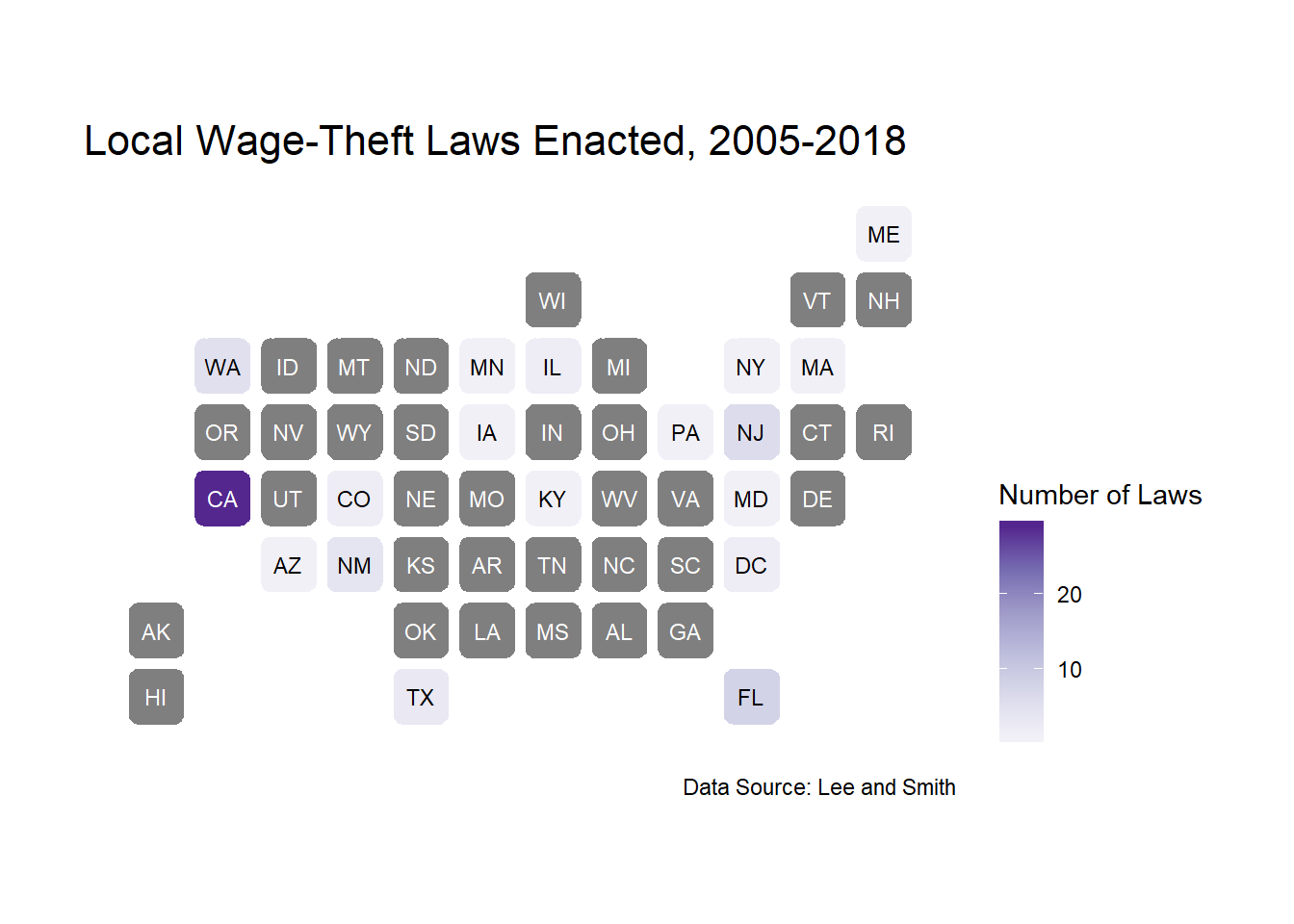
The result: 140 laws (70 State laws and 70 local laws). In absolute numbers, California’s State legislature outpaced other States (19 laws). California had the most local laws, too (29 laws). And many States (the ones in grey) passed no anti-wage-theft laws at all, or at least none that have survived. 
 To figure out what these laws did, Lee and Smith coded each law based on whether it used one or more of 22 distinct legal strategies. Then, they assigned each legal strategy to one of six strategy types: (1) worker complaints; (2) anti-retaliation; (3) penalties; (4) expanded liability; (5) information requirements; and (6) other. Some jurisdictions enacted many strategies in a few pieces of legislation, while others adopted different strategies piecemeal over time.

Overall, the most common strategy type: penalties, that is, not only civil and criminal sanctions, but also license revocation, negative publicity, wage liens, and wage bonds. The least common strategy type: expanded liability, that is, provisions imposing joint and several liability, a broader definition of employer, and successor liability.
After laying out what the laws do, Lee and Smith explain their concern: “Many of the most common anti-wage theft strategies resemble popular and failed regulatory strategies in other contexts, such as rights claiming, command and control enforcement, and information disclosure,” and these strategies aren’t likely to do any better for wage theft (P. 22). Here, their analysis complements recent papers addressing similar concerns.
But their story isn’t all skepticism. Lee and Smith have more hope about the less-common strategies. And here, their attention to local law really pays off.
For example, consider Florida, which effectively got rid of its State department of labor over a decade ago. There, some localities have enacted anti-wage-theft laws that let “any entity” file complaints on behalf of their members, Broward County, Fla., Code § 20½-4(a)(3)(b), or let the local government contract with local NGOs to aid in enforcement, including help filing complaints, recording liens, and enforcing hearing officer orders, see St. Petersburg, Fla., Code §15-47(a). Provisions like these let local governments work with community groups to co-enforce labor standards.
Another promising strategy: burden-shifting. For example, Los Angeles County’s ordinance declares “a rebuttable presumption that an Employer violated this Chapter” if someone alleges that an employee is owed wages under that ordinance and either the employer doesn’t “maintain or retain payroll records required by” the ordinance, or doesn’t allow the county “reasonable access to such records.” Even for the strategy of imposing penalties, a few places go further and require surety bonds for licenses for certain kinds of businesses, such as farm labor contractors in Oregon and New York City car washes.
So, how much do these legal strategies actually reduce wage theft (individually or combined)? And why? To answer those questions, there’s a lot more to learn. Still, thanks to this paper, we now have a better map of where to go to figure that out.
Apr 29, 2019 Joseph Seiner
Andrew Elmore, Franchise Regulation for the Fissured Economy, 86 Geo. Wash. L. Rev. 59 (2018).
An often forgotten area of employment law is the role played by millions of employees working for franchise stores across the country. In his new paper, Franchise Regulation for the Fissured Economy, Professor Andrew Elmore tackles this important area of the workplace, addressing the current standards that govern these workers. Professor Elmore notes the very serious problem of noncompliance in this area with basic employment law, and explains some of the causes that have resulted in this problem.
The franchisee/franchisor relationship is relatively straightforward, as franchisors generally license trademarks to the franchisees. Problematically, in the workplace context, the courts (as a general matter) have failed to consider franchisees as joint employers, which has done little to discourage individual stores from taking unlawful employment actions. While the existing scholarship has focused on the problem of addressing employment law issues arising from subcontractors under the joint employer doctrine, Professor Elmore’s piece takes a different approach. His work proposes that, with respect to franchisors, we should not look to the traditional joint employer test to enhance compliance with employment law. This test does not fit neatly with the construct of most franchise relationships, as the definition of control is currently applied far too narrowly to reach many of the individual stores. In light of this consideration, liability standards must be considered that identify the more unique role franchisors play in the current economy.
More specifically, Professor Elmore looks to other existing theories in the law that could hold franchisors liable for workplace violations. The existing law recognizes apparent agency and misrepresentation theories that could be applied to franchisor relationships. Professor Elmore notes that apparent agency could be used to enhance compliance where franchisors use an internal branding model that creates the perception of franchisor control over regulating employment issues in the stores. Available under the common law as well as certain state statutes, this theory of liability for employment law noncompliance could more specifically address this franchisor-type relationship.
Additionally, Professor Elmore notes that where franchisors adopt business tools or policies that tend to encourage employment law noncompliance, the franchisor may be liable under a misrepresentation theory. Franchisors could thus face liability under this theory if they have not taken reasonable measures to assure that their policies are adopted and applied by individual stores in a way that would not result in workplace violations. Looking at “the dependence and loyalty of franchisees,” the Article considers the “unique incentives in franchising” which can promote workplace wrongs (P. 145). The misrepresentation theory arises from state fraud and franchise laws, and could be directly implicated in the employment context.
Taken together, Professor Elmore sees substantial promise for promoting compliance with workplace laws through a more robust application of apparent agency and misrepresentation theory to franchise relationships. As he discusses, these theories “complement the joint employer test by accounting for the control, dependency, and loyalty measures that franchisors use to protect their brand in franchise stores, including in ways that can encourage employment law violations” (P. 145).
Professor Elmore’s paper is an important and superb piece for several reasons. First, workers who are employed as part of a franchise relationship often face uncertainty when pursuing employment protections. This group – which consists of almost ten million workers – can find themselves left behind when attempting to avail themselves of these basic workplace rights. Professor Elmore takes this problem head on, addressing how the franchise relationship impacts millions of everyday workers. Much of the existing scholarship tackles the more traditional working relationships in our economy, sidestepping this important group of employees. Second, this piece explains the inherent weaknesses of the control test that is so important to the question of the joint employer relationship. Professor Elmore identifies why this often-used test just simply is not a good fit – as currently interpreted – for the franchise economy. The Courts have applied “a narrow right to control test that excludes evidence of the indirect and remote measures that franchisors use to control franchise stores” (P. 105).
Finally, and perhaps most importantly, Professor Elmore looks beyond the traditional control test to other areas of existing law – agency and misrepresentation theories – that can be used to enhance workplace compliance for franchise relationships. Professor Elmore’s solution is particularly creative as it does not suggest a new legal theory or propose new statutory law that is unlikely to be adopted. Rather, Professor Elmore has identified practical ways of working within our existing legal confines to promote compliance with workplace laws for a wide swath of workers that are part of a franchise relationship.
Going forward, the courts should consider applying these theories to franchisors in a broadened way to help enhance the workplace protections of all workers in our economy. As Professor Elmore notes, “lawmaking can elaborate these doctrines to make them more effective in encouraging employment law compliance in franchise stores, particularly in jurisdictions in which these theories are limited by heightened reliance requirements” (P. 106). This creative solution to an existing workplace problem represents an innovative approach that could be broadly adopted. The courts, scholars and lawmakers should examine further the possibility of approaching franchisor liability in the way set forth by this groundbreaking paper.
Apr 15, 2019 Alex B. Long
Leora Eisenstadt,
Data Analytics and the Erosion of the Work/Non-Work Divide, __
Am. Bus. L.J. __ (forthcoming 2019), available at
SSRN.Much has been written in recent years about how technology that is designed to make us all better connected has blurred the line between work and non-work time. For example, in an age in which many non-exempt workers check work email after work hours, on vacation, or on sick leave, defense lawyers have warned their clients about the potential for claims for overtime pay pursuant to the Fair Labor Standards Act (FLSA). Likewise, much has been written about the erosion of employee privacy in an age in which employers increasingly have the ability to use new technology to monitor their employees’ activities.
Professor Leora Eisenstadt’s forthcoming article, Data Analytics and the Erosion of the Work/Non-Work Divide, discusses these same issues, but with a focus on how the ability of employers to collect employees’ off-duty data impacts the erosion of the work/non-work divide. The article examines employers’ “non-transparent use of data analytics to monitor employee behavior, thoughts, and emotions when they are not working and [their ability] to use this data to make decisions about their workplace success” (P. 18).
Professor Eisenstadt provides several examples, including Project Comet, a program that mines data from employees’ social media accounts and then analyzes the information for use by the employer in developing better work teams. These types of programs obviously carry with them the potential for employer misuse. For example, a program that can gather information about an employee’s off-duty health-related internet searches can help an employer identify “which employees are contemplating becoming pregnant, which employees are concerned about developing diabetes, or those who believe they may need back surgery in the near future” (P. 22). While the authors of the Americans with Disabilities Act (ADA) could never have foreseen this type of scenario back in 1990 when the law was passed, the scenario involves the same concerns over disability discrimination that resulted in the ADA placing limits on the ability of employers to make health-related inquiries of employees and applicants.
While the article raises these types of immediate concerns, it also focuses more broadly on the extent to which programs like Project Comet weaken the traditional divide between work and non-work and the broader concerns this raises. The more employers are able to use data analytics to monitor employees’ off-duty activities for use in the workplace, the more muddy traditional employment law rules that are based on this distinction – like the going-and-coming rule in workers’ compensation or overtime laws – become in theory and practice. Moreover, the fact that employers are able to engage in extensive monitoring with only the most minimal level of employee consent raises concerns about the ability of modern workplace privacy laws to effectively deal with these practices. As Eisenstadt notes, several states have lifestyle discrimination statutes that prohibit adverse employment actions based on employees’ lawful off-work activities. However, the concerns raised by employers’ use of data analytics and facial scanning go beyond the concerns that initially motivated many of these statutes.
Ultimately, Eisenstadt’s survey provides the sort of overview that enables a reader to identify broad, big-picture concerns as well as more narrow, issue-specific concerns concerning employer practices in this area. At a time when concerns over the ability of employees to find a work-life balance are growing, Eisenstadt has written a thought-provoking piece about another way in which the work/non-work divide is increasingly crumbling.